
CVSS Explained: How Security Vulnerabilities Get Their Severity Score
SEO Title: CVSS Explained: How Security Vulnerabilities Get Their Severity Score Meta Description: Learn what CVSS means, how vulnerability severity scores are calculated, what CVSS vectors represent, and why a high CVSS score doesn't always mean high business risk. URL Slug: cvss-explained-vulnerability-severity-score Primary Keyword: CVSS explained Secondary Keywords: what is CVSS, CVSS score, CVSS meaning, vulnerability severity score, CVSS calculator, CVSS vector, CVSS 3.1, CVSS 4.0, cybersecurity vulnerabilities
CVSS (Common Vulnerability Scoring System) is the standardized framework security professionals use to describe how severe a vulnerability is — expressed as a score from 0.0 to 10.0, alongside a compact "vector" string like CVSS:3.1/AV:N/AC:L/PR:N/UI:N/S:U/C:H/I:H/A:H that explains exactly what drives that number.
If you've used a scanner like Nessus, Qualys, OpenVAS, or Greenbone, you've seen scores like "9.8 Critical" attached to findings. But where does that number actually come from — and does a 9.8 always mean more danger than a 7.5? Once you understand what each component of the score represents, CVSS becomes far less intimidating than it looks.
This guide covers:
- What CVSS means and how scores are calculated
- What a CVSS vector represents, piece by piece
- The difference between CVE and CVSS
- CVSS v3.1 vs. CVSS v4.0
- Why CVSS is not the same as business risk
- Common mistakes beginners make when reading a score
What Does CVSS Stand For?
CVSS stands for Common Vulnerability Scoring System — a standardized framework, maintained by the Forum of Incident Response and Security Teams (FIRST), for describing vulnerability severity.
Instead of a vague statement like "this looks pretty serious," CVSS gives security teams a structured, comparable score and vector. Saying "CVSS: 9.8" communicates far more precisely than "very dangerous."
What Is a CVSS Score?
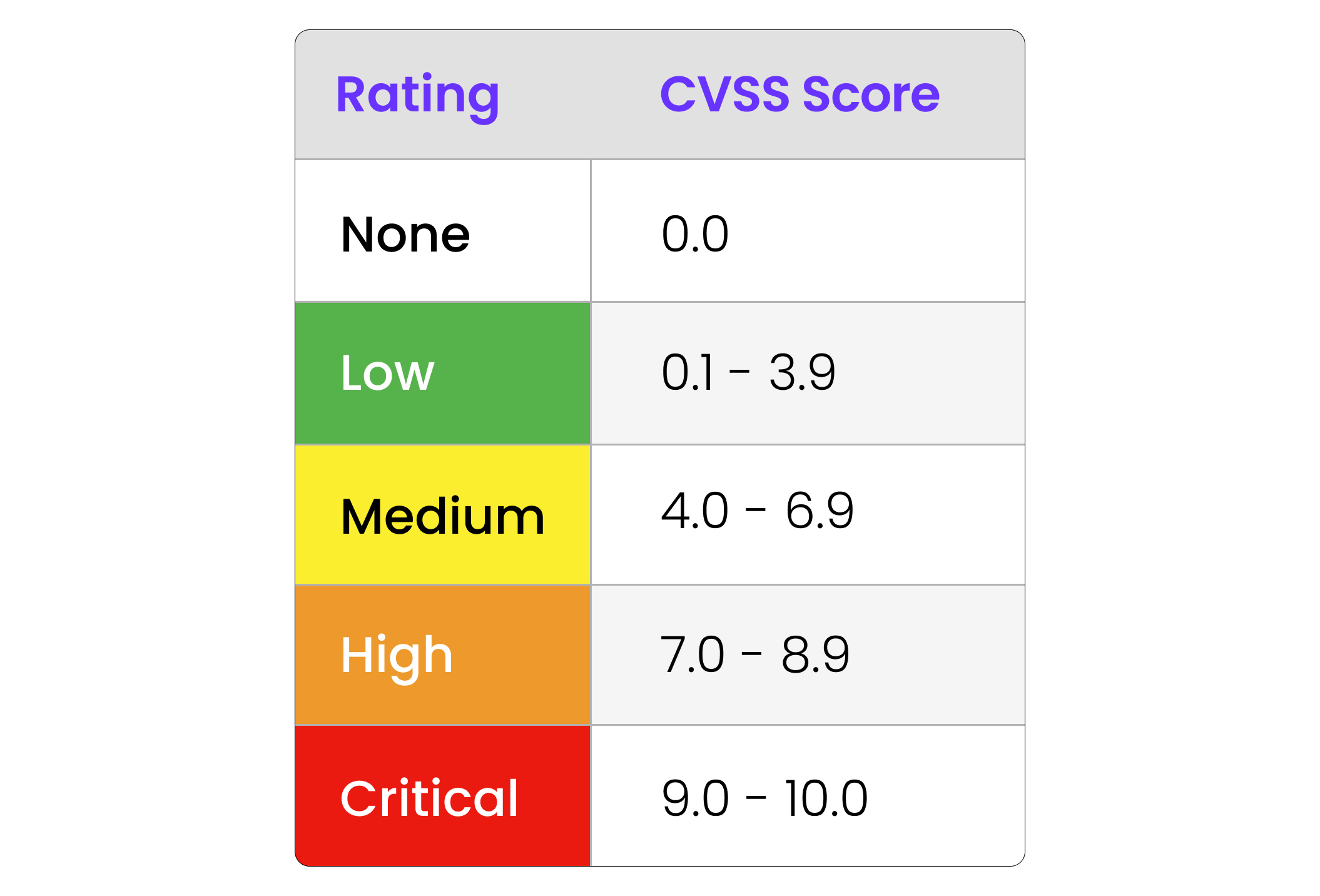
A CVSS score is a number from 0.0 to 10.0 representing severity under the CVSS methodology:
| Score | Severity |
|---|---|
| 0.0 | None |
| 0.1–3.9 | Low |
| 4.0–6.9 | Medium |
| 7.0–8.9 | High |
| 9.0–10.0 | Critical |
Important: a CVSS score is not the same as your organization's actual risk — more on that below.
CVE vs. CVSS: What's the Difference?
These two terms often appear together, but they answer different questions:
- CVE (Common Vulnerabilities and Exposures) — identifies which vulnerability you're looking at. Example:
CVE-2026-12345 - CVSS — describes how severe that vulnerability is. Example:
CVSS: 9.8
A fully documented vulnerability typically combines both: CVE-2026-12345 — CVSS: 9.8 Critical.
How Is a CVSS Score Calculated?
CVSS doesn't just eyeball how dangerous something looks — it evaluates a defined set of characteristics grouped into three categories:
- Base Metrics — the intrinsic, unchanging characteristics of the vulnerability
- Temporal Metrics — characteristics that shift over time (exploit availability, patch status)
- Environmental Metrics — adjustments based on your own organization's context
CVSS v4.0 reorganizes and expands this framework with added threat and environmental considerations, but for beginners, Base Metrics are the right place to start.
CVSS v3.1 Base Metrics, Explained
A typical base vector looks like this:
CVSS:3.1/AV:N/AC:L/PR:N/UI:N/S:U/C:H/I:H/A:H
It looks dense, but each piece maps to one clear question.
Attack Vector (AV) — how can the vulnerability be reached?
| Value | Meaning |
|---|---|
| N | Network — exploitable remotely |
| A | Adjacent — requires a nearby network |
| L | Local — requires local system access |
| P | Physical — requires physical device access |
Attack Complexity (AC) — how hard is exploitation once access exists?
L(Low) — no unusual conditions requiredH(High) — depends on conditions that are difficult to reproduce, like a race condition
Privileges Required (PR) — what access does the attacker need beforehand?
N(None),L(Low), orH(High) privileges
User Interaction (UI) — does a victim need to do something (click a link, open a file)?
N(None) orR(Required)
Scope (S) — can the exploit affect resources beyond its original security boundary?
U(Unchanged) orC(Changed) — this one trips up most beginners, but it matters because some vulnerabilities let attackers cross into a different security context entirely
Confidentiality, Integrity, Availability (C / I / A) — the potential impact on each, each rated N (None), L (Low), or H (High)
Putting It Together
Translating our example vector:
| Metric | Value | Meaning |
|---|---|---|
| AV | N | Network |
| AC | L | Low complexity |
| PR | N | No privileges needed |
| UI | N | No user interaction needed |
| S | U | Scope unchanged |
| C / I / A | H / H / H | High impact across the board |
That combination of "easy to reach, easy to exploit, and severely damaging" is exactly what produces a very high base score. The goal isn't memorizing the formula — it's understanding why each value was assigned.
What Is a CVSS Vector, and Why Does It Matter?
The vector is the compact string encoding all those metric values. Two vulnerabilities can share an identical score — say, both at 8.8 — while having completely different vectors: one might require authentication and local access, the other might be exploitable remotely with zero privileges. The score alone doesn't tell the whole story; the vector does.
Temporal and Environmental Metrics
Temporal Metrics account for things that change after disclosure:
- Exploit Code Maturity — how available/mature is exploit code?
- Remediation Level — is there an official fix or workaround yet?
- Report Confidence — how confident are we the vulnerability is real and correctly described?
Environmental Metrics let organizations adjust for their own context — the same vulnerability matters far more on an internet-facing production server handling sensitive data than on an isolated machine scheduled for retirement.
CVSS v3.1 vs. CVSS v4.0
CVSS v4.0 introduces a more detailed and expressive framework: a revised metric structure, changes to scope-related concepts, separate threat considerations, and additional environmental context. Vectors are easy to tell apart — v4.0 vectors start with CVSS:4.0/, while v3.1 vectors start with CVSS:3.1/. Use whichever version your source provides, and don't treat scores from different versions as directly interchangeable.
Why Does a Vulnerability Score 9.8?
A score that high usually reflects a dangerous combination: network-reachable, low complexity, no privileges needed, no user interaction required, and high impact to confidentiality, integrity, and availability. That said — a 9.8 describes severity characteristics under the CVSS methodology. It is not a prediction that the vulnerability will definitely be exploited.
CVSS vs. Real-World Risk
This is the single most important lesson for anyone new to vulnerability management.
Compare:
- Vulnerability A — CVSS 10.0, sitting on a fully isolated server with no sensitive data
- Vulnerability B — CVSS 8.1, on an internet-facing system handling critical business data, with evidence of active exploitation
Which deserves attention first? CVSS alone can't answer that. Real risk is closer to:
Vulnerability + Asset Importance + Exposure + Exploitability + Threat Activity + Business Impact = Overall Risk
Sorting your entire backlog purely by descending CVSS score is not a remediation strategy — it's a shortcut that can leave your most exploitable, most exposed systems waiting behind theoretical high scores on low-value assets.
What About EPSS and KEV?
Two other signals worth knowing:
- EPSS (Exploit Prediction Scoring System) — estimates the probability a vulnerability will be exploited in the wild within a given timeframe. Where CVSS asks "how severe is this?", EPSS asks "how likely is exploitation?"
- CISA's Known Exploited Vulnerabilities (KEV) Catalog — flags vulnerabilities with confirmed active exploitation, a strong signal for prioritization
A mature approach combines CVSS + EPSS + KEV status + exposure + asset criticality + business impact — not CVSS in isolation.
A Practical Prioritization Example
| Vulnerability | CVSS | Exposure | Asset | Exploitation |
|---|---|---|---|---|
| A | 9.8 | Internal | Test server | Unknown |
| B | 8.6 | Internet-facing | Production server | Confirmed |
| C | 7.5 | Internet-facing | Critical system | Unknown |
A CVSS-only ranking says A → B → C. A risk-based approach says B → C → A, because B is actively exploited on an internet-facing production system — exactly the kind of gap that pure score-sorting misses.
Common CVSS Mistakes Beginners Make
- Treating CVSS as a complete risk score rather than one input among several
- Stopping at the number instead of reading the vector and description
- Assuming every 9.8 is equally dangerous, regardless of environment
- Ignoring active exploitation in favor of chasing the highest score
- Ignoring asset criticality — the same vulnerability means different things on a critical server vs. an isolated test box
- Confusing CVE with CVSS — one identifies, the other scores
- Assuming a high score guarantees exploitation — it describes severity, not certainty
How to Analyze a CVSS Finding, Step by Step
- Identify the CVE
- Check the CVSS version (3.1 or 4.0)
- Read the full vector, not just the score
- Confirm whether your actual version/configuration is affected
- Check the vendor advisory for patches and mitigations
- Check EPSS and KEV status for exploitation intelligence
- Weigh the asset's importance and exposure
- Prioritize remediation using CVSS as one input, not the whole decision
Cheat Sheet
| Term | Meaning |
|---|---|
| CVSS | Common Vulnerability Scoring System |
| Score range | 0.0–10.0 |
| CVE | Vulnerability identifier |
| Vector | Compact string representing CVSS metrics |
| AV / AC / PR / UI / S | Attack Vector / Complexity / Privileges Required / User Interaction / Scope |
| C / I / A | Confidentiality / Integrity / Availability impact |
| EPSS | Exploit Prediction Scoring System |
| KEV | CISA's Known Exploited Vulnerabilities Catalog |
Frequently Asked Questions
What is CVSS in simple terms? A standardized system for scoring vulnerability severity using a numeric score and a detailed metric vector.
Is CVSS 9.8 critical? Yes — under the CVSS v3.x scale, 9.0–10.0 falls into the Critical band.
Is CVSS the same as CVE? No. A CVE identifies a specific vulnerability; CVSS scores how severe it is.
Should I always patch a CVSS 10 vulnerability first? Not automatically. Weigh it against asset criticality, exposure, confirmed exploitation, and available mitigations before deciding priority.
What is CVSS 4.0?
A newer version of the scoring system with revised metrics and added threat/environmental context, distinguished by vectors starting with CVSS:4.0/.
Final Thoughts
A CVSS score is the start of an analysis, not the end of one. It tells you how severe a vulnerability is under a standardized methodology — but real prioritization means also asking whether the system is exposed, whether the vulnerable component is actually present, whether exploitation is happening in the wild, and how much the affected asset actually matters to the business. That shift — from reading a number to understanding risk — is one of the most valuable skills in vulnerability management, SOC work, or penetration testing.
Continue Learning
- What Is a CVE? — how vulnerabilities get standardized identifiers
- CVSS Explained — this guide
- CVE vs CVSS vs CWE — identifiers, scoring, and weakness categories compared
- What Is Vulnerability Management? — how organizations discover, prioritize, and remediate
- Vulnerability Assessment vs. Penetration Testing — finding vs. exploiting
SEO Settings for Blogger
SEO Title: CVSS Explained: How Security Vulnerabilities Get Their Severity Score URL Slug: cvss-explained-vulnerability-severity-score Meta Description: Primary Keyword: CVSS explained Secondary Keywords: what is CVSS, CVSS score, CVSS meaning, vulnerability severity score, CVSS calculator, CVSS vector, CVSS 3.1, CVSS 4.0, CVE vs CVSS, cybersecurity vulnerabilities, vulnerability management Suggested Labels: Cybersecurity, CVSS, Vulnerability Management, Cybersecurity Basics, CVE, Vulnerability Assessment, Information Security, Cybersecurity Fundamentals Featured Image Alt Text: CVSS explained vulnerability severity score and cybersecurity risk
Note: Keep this on CyberThreatUpdate, not Money Made Simple — it pairs directly with your "What Is a CVE?" article as part of a cybersecurity-fundamentals content cluster (CVE → CVSS → CVE vs CWE → Vulnerability Management → Vulnerability Assessment).