
OWASP Top 10:2025 Explained: A Beginner's Guide to Web Application Security
If you've spent any time learning web application security, penetration testing, ethical hacking, or application security, you've probably heard of the OWASP Top 10.
But what exactly is it?
Why is it important?
And what's new in the OWASP Top 10:2025?
The OWASP Top 10 is one of the most widely recognized references for understanding the most critical security risks affecting web applications.
The latest edition introduces important changes to the previous 2021 list, including new categories, changes in ranking, and a broader focus on modern application and software supply-chain security.
Whether you're a beginner learning cybersecurity, a developer building web applications, or a security professional performing vulnerability assessments, understanding the OWASP Top 10 gives you an important foundation for identifying and discussing application security risks.
In this guide, we'll explain the OWASP Top 10:2025 in simple terms, explore what's changed since 2021, and explain why each category matters.
What Is OWASP?
OWASP stands for Open Worldwide Application Security Project.
It is a nonprofit foundation focused on improving software and application security.
OWASP is community-driven and vendor-neutral, and it provides security resources, projects, tools, documentation, and educational material for developers and security professionals.
One of its best-known resources is the:
OWASP Top 10
The project has been published periodically since 2003 and has become an important reference point for web application security.
What Is the OWASP Top 10?
The OWASP Top 10 is an awareness and prioritization document that highlights major security risks affecting web applications.
It is designed to help:
- Developers understand common application security risks
- Security teams prioritize security testing
- Penetration testers organize findings
- Organizations improve secure development practices
- Students learn application security fundamentals
It's important to understand that the OWASP Top 10 is not a complete list of every web vulnerability.
It is also not:
- A penetration-testing checklist
- A vulnerability scanner
- A certification
- A replacement for secure coding practices
- A legal compliance standard
Instead, it provides a high-level framework for understanding important application security risks.
OWASP Top 10:2025 — Complete List
The OWASP Top 10:2025 contains the following categories:
| Rank | OWASP Top 10:2025 Category | 2021 Position |
|---|---|---|
| A01 | Broken Access Control | #1 |
| A02 | Security Misconfiguration | #5 |
| A03 | Software Supply Chain Failures | New / Expanded |
| A04 | Cryptographic Failures | #2 |
| A05 | Injection | #3 |
| A06 | Insecure Design | #4 |
| A07 | Authentication Failures | #7 |
| A08 | Software or Data Integrity Failures | #8 |
| A09 | Security Logging & Alerting Failures | #9 |
| A10 | Mishandling of Exceptional Conditions | New |
The biggest changes include the addition of Software Supply Chain Failures and Mishandling of Exceptional Conditions, along with significant changes in ranking.
OWASP Top 10:2021 vs 2025
One of the easiest ways to understand the new edition is to compare it with the previous list.
| 2021 | 2025 |
|---|---|
| A01 Broken Access Control | A01 Broken Access Control |
| A02 Cryptographic Failures | A02 Security Misconfiguration |
| A03 Injection | A03 Software Supply Chain Failures |
| A04 Insecure Design | A04 Cryptographic Failures |
| A05 Security Misconfiguration | A05 Injection |
| A06 Vulnerable and Outdated Components | A06 Insecure Design |
| A07 Identification and Authentication Failures | A07 Authentication Failures |
| A08 Software and Data Integrity Failures | A08 Software or Data Integrity Failures |
| A09 Security Logging and Monitoring Failures | A09 Security Logging & Alerting Failures |
| A10 SSRF | A10 Mishandling of Exceptional Conditions |
The changes show how application security is evolving beyond traditional coding vulnerabilities toward configuration, supply chains, operational behavior, and system resilience.
A01: Broken Access Control
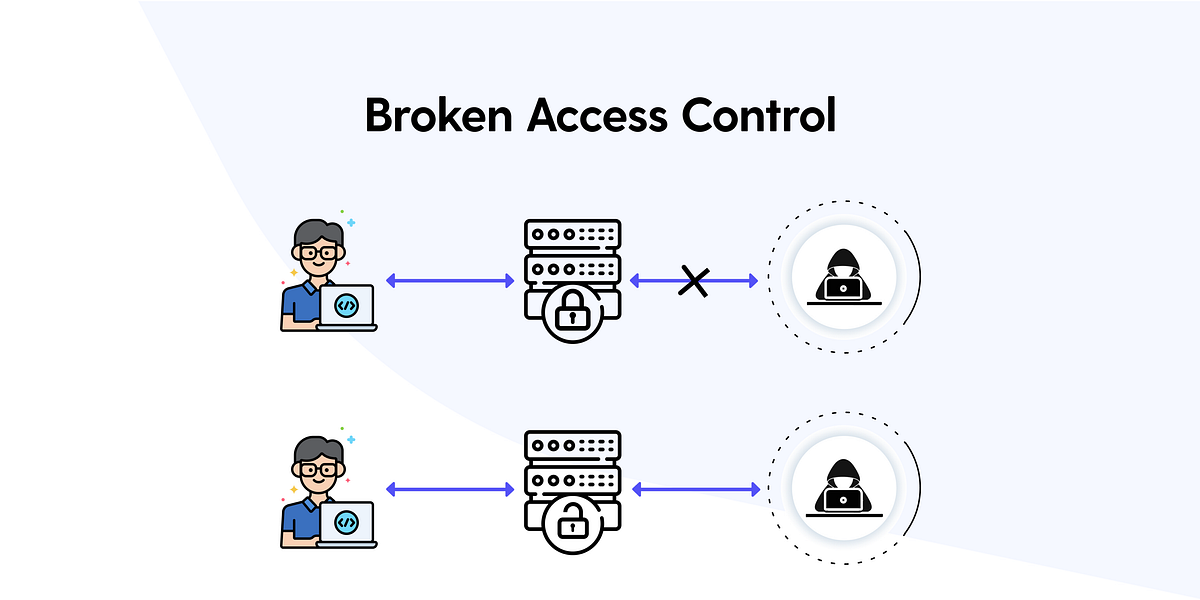
Broken Access Control remains at the top of the OWASP Top 10.
Access control determines what an authenticated or unauthenticated user is allowed to access or modify.
A vulnerability occurs when an application fails to properly enforce those permissions.
For example, imagine a website where users access their profile through:
/account/1001
If changing the number to:
/account/1002
allows one user to view another user's private information, the application may have an access-control vulnerability.
This type of vulnerability is commonly associated with issues such as:
- IDOR/BOLA
- Privilege escalation
- Unauthorized data access
- Missing authorization checks
- Accessing administrative functionality without permission
Why it matters
Broken access control can allow attackers to access information or functionality they shouldn't have access to.
A02: Security Misconfiguration
Security Misconfiguration moved significantly higher in the 2025 ranking.
This category covers insecure configuration of applications, servers, frameworks, cloud services, databases, and other components.
Examples include:
- Default passwords
- Unnecessary services
- Debug mode enabled in production
- Excessive permissions
- Missing security headers
- Exposed administrative interfaces
- Improper cloud configuration
- Verbose error messages
- Unnecessary features enabled
A secure application can still become vulnerable because of an insecure deployment configuration.
Simple example
A developer deploys an application with:
DEBUG = TRUE
on a production server.
That configuration could expose sensitive debugging information.
Why it matters
Modern applications depend heavily on infrastructure and configuration, making secure configuration an important part of application security.
A03: Software Supply Chain Failures

One of the most significant changes in the 2025 edition is the introduction of Software Supply Chain Failures.
Modern applications rarely consist entirely of code written by one development team.
They depend on:
- Open-source packages
- Third-party libraries
- Container images
- Build systems
- CI/CD pipelines
- Package repositories
- Development tools
- Cloud services
- Software vendors
This creates a large software supply chain.
If something goes wrong somewhere in that chain, the application can potentially be affected.
Example
A web application depends on:
Application
    ↓
Third-party library
    ↓
Package repository
    ↓
Build pipeline
    ↓
Production deployment
A compromise in one part of that chain could potentially affect downstream applications.
Why it matters
Software supply-chain attacks can have a very large impact because one compromised component can potentially affect many users or organizations.
A04: Cryptographic Failures
Cryptographic Failures involve weaknesses in how applications protect sensitive information.
Examples include:
- Weak encryption
- Improper cryptographic implementations
- Poor key management
- Transmitting sensitive information without adequate protection
- Storing sensitive data insecurely
- Using outdated cryptographic algorithms
Sensitive information may include:
- Passwords
- Authentication tokens
- Personal information
- Financial information
- API credentials
- Confidential business data
Important lesson
Encryption isn't simply about "using encryption."
Developers need to use appropriate algorithms, configurations, keys, protocols, and storage mechanisms correctly.
A05: Injection
Injection is one of the most well-known application security risks.
Injection occurs when untrusted data is interpreted as part of a command or query.
Common examples include:
- SQL injection
- Command injection
- LDAP injection
- NoSQL injection
- Cross-site scripting in relevant contexts
For example, an application might construct a database query using untrusted input without proper handling.
Instead of treating the input as data, the underlying system may interpret part of it as instructions.
How to prevent injection
Common defensive approaches include:
- Parameterized queries
- Proper input handling
- Context-aware output encoding
- Safe APIs
- Avoiding unnecessary command execution
- Secure coding practices
A06: Insecure Design
Insecure Design focuses on security weaknesses that originate at the design level.
This is different from simply having a coding mistake.
A perfectly implemented feature can still be insecure if the underlying design doesn't account for security requirements.
Examples include:
- Missing abuse-case analysis
- Weak business logic
- Insufficient security controls
- Missing rate limits
- Unsafe workflows
- Poor authorization architecture
Simple example
Imagine a password-reset system that allows unlimited reset attempts.
Even if the code is technically functioning as designed, the design itself may not adequately address abuse.
Security needs to be considered during the design stage—not added only after development is finished.
A07: Authentication Failures

Authentication determines whether someone is actually who they claim to be.
Authentication failures can involve weaknesses such as:
- Weak authentication mechanisms
- Poor password policies
- Improper session management
- Missing protections against automated attacks
- Weak account recovery
- Poor credential handling
A compromised authentication system can provide attackers with access to user accounts.
Good authentication practices
Organizations should consider:
- Strong authentication
- Multi-factor authentication
- Secure session management
- Rate limiting
- Secure password storage
- Account-recovery protections
A08: Software or Data Integrity Failures

This category focuses on situations where applications trust software, updates, code, or data without adequately verifying their integrity.
Potential areas include:
- Software updates
- CI/CD pipelines
- Serialized data
- Third-party components
- Build processes
The underlying problem is often trust without sufficient verification.
For example, if an application blindly trusts an externally supplied component without verifying its integrity, an attacker who compromises that component could potentially affect the application.
A09: Security Logging & Alerting Failures
Security logging is extremely important because organizations can't investigate what they cannot see.
Applications should generate appropriate security-related events and make those events useful for monitoring and investigation.
Problems can include:
- Missing security logs
- Insufficient authentication logging
- Poor alerting
- Logs that don't contain useful context
- Failure to monitor important security events
- Logs that are easily modified or deleted
Imagine an attacker compromises an account.
If the application doesn't properly record:
Login attempt
IP address
Timestamp
Account
Authentication result
investigators may have difficulty determining what happened.
Why logging matters
Good logging supports:
Detection → Investigation → Response → Recovery
A10: Mishandling of Exceptional Conditions
One of the new categories in the OWASP Top 10:2025 is:
Mishandling of Exceptional Conditions
Applications don't always operate under normal conditions.
They encounter:
- Errors
- Unexpected input
- Network failures
- Resource exhaustion
- Invalid states
- Timeouts
- Race conditions
- Unexpected system behavior
Security problems can occur when applications don't handle these situations safely.
For example, an application might:
Normal condition
      ↓
Security check
      ↓
Access denied
But under an unexpected error:
Unexpected condition
      ↓
Error occurs
      ↓
Security check skipped
      ↓
Access accidentally granted
This type of behavior can create security weaknesses.
Why Did the OWASP Top 10 Change?
The threat landscape changes constantly.
Applications today are very different from many applications built years ago.
Modern software frequently depends on:
- Cloud infrastructure
- APIs
- Open-source libraries
- Microservices
- Containers
- CI/CD pipelines
- Third-party services
- SaaS platforms
As application architecture changes, security risks change as well.
The OWASP Top 10:2025 reflects this broader ecosystem.
OWASP Top 10 Is Not Just for Penetration Testers
One misconception is that the OWASP Top 10 is only useful for ethical hackers.
It isn't.
Developers
Can use it to build more secure applications.
Security analysts
Can use it to understand application-security findings.
Penetration testers
Can use it as a framework for organizing security testing.
DevSecOps teams
Can integrate security considerations into development pipelines.
Security managers
Can use it to communicate application security risks.
Cybersecurity students
Can use it as a foundation for learning web application security.
OWASP Top 10 and Penetration Testing
The OWASP Top 10 can be useful during an authorized penetration test.
For example, a tester may investigate whether an application has weaknesses involving:
Access Control
       ↓
Authentication
       ↓
Injection
       ↓
Configuration
       ↓
Cryptography
       ↓
Logging
       ↓
Business Logic
However, the OWASP Top 10 should not be treated as a complete penetration-testing methodology.
A professional assessment should consider the application's architecture, business logic, APIs, authentication mechanisms, infrastructure, and specific threat model.
OWASP Top 10 vs CVE vs CWE
These concepts are often confused.
Here's an easy way to remember them:
| System | Purpose |
|---|---|
| CVE | Identifies a specific publicly known vulnerability |
| CWE | Categorizes a type of software weakness |
| CVSS | Scores vulnerability severity |
| OWASP Top 10 | Groups and prioritizes major web application security risks |
For example:
CVE
↓
Specific vulnerability

CWE
↓
Weakness type

CVSS
↓
Severity

OWASP Top 10
↓
Broader application-security risk category
If you're learning cybersecurity, understanding the difference between these four concepts is extremely useful.
Is the OWASP Top 10 a Compliance Standard?
No.
The OWASP Top 10 is primarily an awareness and prioritization document.
Organizations may use it as part of:
- Security assessments
- Developer training
- Secure coding programs
- Security reviews
- Procurement processes
- Application security programs
But simply claiming:
"We comply with the OWASP Top 10"
doesn't automatically mean an application is secure.
Security requires a broader approach.
How Developers Can Use the OWASP Top 10
A practical secure-development process could look like:
Design
  ↓
Threat Modeling
  ↓
Secure Coding
  ↓
Code Review
  ↓
Automated Security Testing
  ↓
Dependency Management
  ↓
Dynamic Testing
  ↓
Security Monitoring
  ↓
Continuous Improvement
The OWASP Top 10 can provide useful guidance throughout this process.
How Beginners Should Learn the OWASP Top 10
If you're new to application security, don't try to memorize all ten categories immediately.
Instead, learn them conceptually.
Start with:
Step 1
Understand Broken Access Control.
Step 2
Learn Security Misconfiguration.
Step 3
Study Injection.
Step 4
Understand Authentication.
Step 5
Learn Cryptographic Failures.
Step 6
Study Insecure Design.
Step 7
Learn about software supply chains.
Step 8
Study logging, integrity, and exceptional conditions.
Then practice identifying these risks in intentionally vulnerable applications and authorized labs.
Frequently Asked Questions About OWASP Top 10:2025
What is the OWASP Top 10?
The OWASP Top 10 is an awareness document that identifies and prioritizes major security risks affecting web applications.
What is the latest OWASP Top 10?
The latest edition is OWASP Top 10:2025.
How many categories are in the OWASP Top 10?
There are 10 categories, numbered A01 through A10.
What is A01 in OWASP Top 10:2025?
A01 is Broken Access Control.
What is A02 in OWASP Top 10:2025?
A02 is Security Misconfiguration.
What is new in OWASP Top 10:2025?
The 2025 edition introduces Software Supply Chain Failures and Mishandling of Exceptional Conditions as new categories, while other categories have been renamed, reorganized, or repositioned.
Is OWASP Top 10 a vulnerability scanner?
No. OWASP Top 10 is a security-risk awareness and prioritization framework, not a scanning tool.
Is OWASP Top 10 useful for beginners?
Yes. It provides an excellent starting point for learning fundamental web application security concepts.
Is OWASP Top 10 a compliance standard?
No. It is not itself a legal or regulatory compliance standard.
Is OWASP Top 10 the same as CVE?
No. CVE identifies specific vulnerabilities, while OWASP Top 10 categorizes broader application-security risks.
Conclusion
The OWASP Top 10:2025 is more than a list of vulnerabilities.
It's a way of thinking about application security.
The latest edition highlights how modern applications are affected not only by traditional coding problems but also by:
- Access-control weaknesses
- Security misconfiguration
- Software supply-chain risks
- Cryptographic problems
- Injection
- Insecure design
- Authentication failures
- Integrity issues
- Logging failures
- Unexpected application conditions
If you're learning ethical hacking, penetration testing, bug bounty hunting, application security, or cybersecurity, understanding these ten categories is an excellent starting point.
But don't stop at memorizing the names.
The real value comes from understanding why these vulnerabilities happen, how they can be identified, how they affect organizations, and how developers can prevent them.
That's where the OWASP Top 10 becomes practical cybersecurity knowledge rather than just another list to memorize.
What's Next?
We'll explore each OWASP Top 10:2025 category in a separate beginner-friendly guide.
Recommended reading order:
- A01: Broken Access Control Explained
- A02: Security Misconfiguration Explained
- A03: Software Supply Chain Failures Explained
- A04: Cryptographic Failures Explained
- A05: Injection Explained
- A06: Insecure Design Explained
- A07: Authentication Failures Explained
- A08: Software or Data Integrity Failures Explained
- A09: Security Logging & Alerting Failures Explained
- A10: Mishandling of Exceptional Conditions Explained